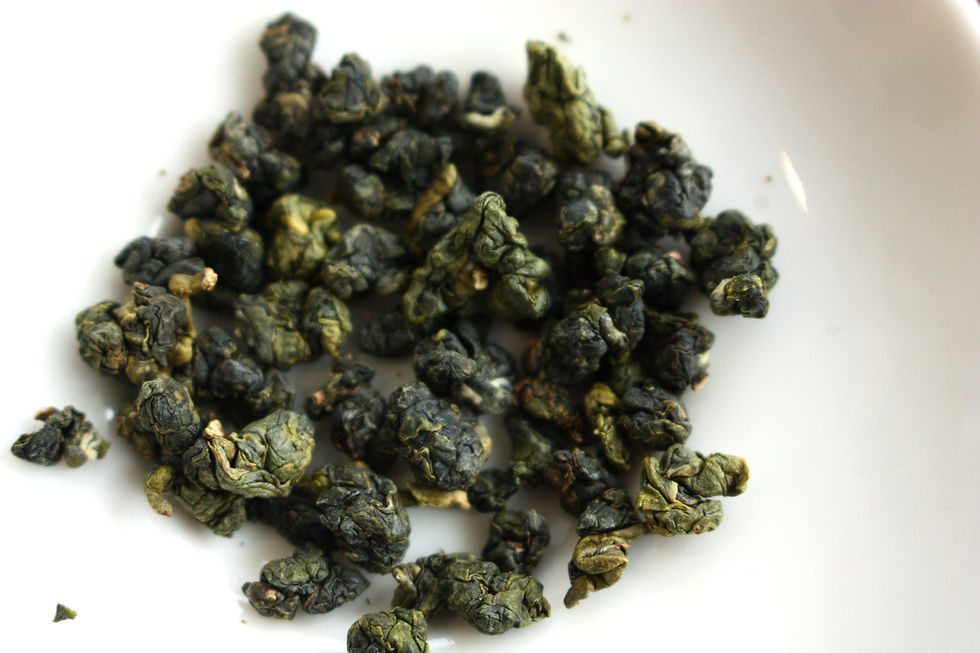
#014 Sanshia Longjing Green Tea|三峡龍井緑茶
Located in northern Taiwan, **Sanxia** (formerly known as *Sankakuyong*) is renowned as Taiwan's premier green tea-producing region. The area is best known for its pan-fired green tea, **Bi-Lo-Chung**, but it is also one of the few places in Taiwan that still produces the rare **Longjing (Long-Chin) Tea**.


Tea has been cultivated in Sanxia since the Qing Dynasty. During the Japanese colonial period (1895–1945), the region became a major tea production center, manufacturing black tea for export as well as **xiangpian**—green tea processed for scenting with flowers such as jasmine and osmanthus, which was widely consumed in Hong Kong. At that time, East Asia's largest tea factory was built in Sanxia, making it one of the most important tea-producing regions in Taiwan.


The Birth of Taiwan's Long-Chin Tea
Green tea production in Sanxia began during the 1950s after World War II.
Many officials of the Republic of China government who relocated to Taiwan after the war came from **Zhejiang Province**, the home province of President **Chiang Kai-shek**. They longed for the famous **West Lake Longjing Tea** from Hangzhou—one of China's Ten Famous Teas—and demand for it was enormous among the approximately **1.02 million mainland Chinese who had moved to Taiwan**.
However, the Chinese Civil War had only recently ended, military conflicts still continued around offshore islands and coastal regions, and travel across the Taiwan Strait was prohibited. Importing authentic West Lake Longjing Tea from mainland China was therefore impossible.
As a result, Taiwan began producing its own Long-Chin tea, and **Sanxia**, already famous for manufacturing green tea for scented teas, became the ideal location.


West Lake Longjing vs. Sanxia Long-Chin
One of the defining characteristics of **West Lake Longjing** is the use of extremely tender young shoots, typically consisting of **one bud and one leaf**.
During processing, the leaves are hand-pressed against the curved surface of a large wok while being dried. This means that the **kill-green** process—where heat deactivates the enzymes responsible for oxidation—occurs simultaneously with shaping. Because some oxidation continues during shaping, the finished leaves develop a slightly yellow-green appearance.
**Sanxia Long-Chin** follows a different process. The leaves first undergo pan-firing to complete the kill-green stage before being transferred onto a flat iron plate heated to approximately **100°C (212°F)**, where they are hand-pressed into their characteristic flat shape. As a result, Sanxia Long-Chin retains a noticeably greener appearance than its West Lake counterpart.


Rise and Decline
From the 1950s through the 1970s, Sanxia Long-Chin experienced its golden age. At its peak, Sanxia even hosted **Taiwan's only fresh tea leaf trading market**, making the town a vibrant center of tea commerce.
However, most Longjing drinkers in Taiwan were first-generation immigrants from mainland China. As that generation gradually passed away, demand for Sanxia Long-Chin steadily declined.
At the same time, Taiwanese consumers increasingly preferred the smoother taste of oolong tea over the stronger flavor of green tea. Compared with the major tea-producing regions of central Taiwan, Sanxia's tea-growing area shrank dramatically—from approximately **2,500 hectares in the 1990s to only around 250 hectares today**.
Long-Chin tea can only be produced from carefully hand-picked leaves, and rising labor costs, coupled with younger generations leaving rural communities for cities, have made production increasingly difficult.
Many tea professionals believe that within the next decade there may be no artisans left capable of producing authentic Sanxia Long-Chin Tea.
Since green tea is best enjoyed while fresh, now is one of the last opportunities to experience this increasingly rare tea handcrafted by the few remaining masters.


Chin-Shin-Ganzai – A Unique Local Cultivar
The tea trees grown in Sanxia belong primarily to **Chin-Shin-Ganzai**, a traditional local cultivar unique to the region.
All of Sanxia's green tea, oolong tea, and black tea are produced from this variety. Its distinctive characteristic is a lingering citrus-peel aroma that beautifully complements the pleasantly bittersweet finish of green tea.
In recent years, more tea gardens have adopted pesticide-free and organic cultivation methods. By allowing natural leafhopper activity, they also produce highly aromatic **Oriental Beauty** and **Honey Black Tea**, both expressing the unique character of the Chin-Shin-Ganzai cultivar that cannot be replicated elsewhere.


Mingqian Tea
The finest Sanxia Long-Chin is considered to be **Mingqian Tea**, referring to tea harvested before **Qingming Festival** (around April 5).
While most spring teas are harvested on or after Qingming, Longjing is prized for its exceptionally tender young buds. Therefore, the highest-grade Longjing is often picked even earlier.
The tiny silvery hairs (*hao*) covering the young buds appear white when dry. Once brewed, these fine hairs may float on the surface of the tea, resembling tiny specks of dust. This is a natural characteristic of premium-quality Longjing tea and a sign of its exceptional quality.


Aroma & Flavor: Chestnut, roasted seaweed, mineral salt, mung bean, citrus, ginger, and floral notes.
Processing: Harvest → Withering → Pan-firing (Shaqing) → Rolling → Drying
Origin: Tian Fang Tea Garden, Sanxia District, New Taipei City, Taiwan
Cultivar: Chin-Shin-Ganzai
Elevation: 200 meters
Oxidation: ☆☆☆☆☆ (Non-oxidized)
Roast Level: ☆☆☆☆☆ (Unroasted)
Harvest Season: February–March
Storage: After opening, store away from direct sunlight and humidity, and consume as soon as possible to preserve freshness.


**Tea-to-Water Ratio** (5g tea leaves : 150ml hot water)
**Water Temperature** 90°C (194°F)
**Steeping Time**
1st infusion: 1 min 30 sec
2nd infusion: 30 sec
3rd infusion: 30 sec


For the fullest appreciation of the tea's fragrance, the use of a traditional Taiwanese aroma cup together with a tasting cup is recommended.


Cold Brew
* 5 g tea leaves
* 600 ml cold water
* Refrigerate for **6–8 hours**.
International shipping fee
Returns & Refunds
Shopping Guide